
204 results for “french”
We have found 204 results with the word you searched.

What’s new at Brilliant Publications? (12 May 2022)
Here is what has been happening in the office this week. Why not hold a French Phonics Festival? Catherine Cantin, co-author of 21 Fun Songs to Teach French Phonics, is going to be leading her first French Phonics Festival today with Amanda MacRae, using songs and worksheets from her book.
Continue
What’s new at Brilliant Publications? (7 Apr 2022)
On Monday we were delighted and honoured to find out that we've been shortlisted for the IPA Education Publisher of the Year award for the second year in a row.
ContinueWhat’s new at Brilliant Publications? (31 March 2022)
Did you know today is Eiffel Tower Day? It marks the completion in 1889. The lifts weren’t in operation for the launch, so the attendees had to use the stairs.
Continue
What’s new at Brilliant Publications? (24 March 2022)
How many books would you guess are published in the UK per day? I was shocked to read there's an average of 458 new titles released per day (Nielsen BookData).
Continue
What’s new at Brilliant Publications? (10 Mar Newsletter)
Here is what has been happening in the office this week. What a 'cracking' cover! This morning we received our advance copies of Cracking English Grammar in KS2.
Continue
Les Problèmes Logiques et Latéraux
The puzzles in this book are a fun and engaging way to practise reading French. They are designed to consolidate and extend French vocabulary on a variety of topics whilst training the participant's brain to solve problems. Scroll down to find out more and download ‘Try before you buy’ sample pages from the book.
Select options This product has multiple variants. The options may be chosen on the product page Continue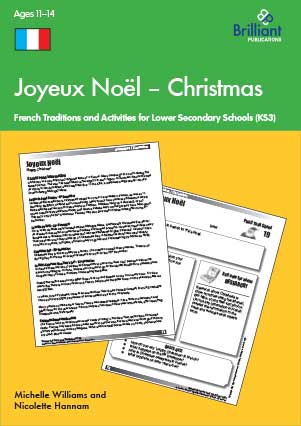
Joyeux Noël – Christmas (KS3)
Use French festivals and traditions to bring your French Christmas topic alive! This pack contains background information on how Christmas is celebrated in France, from La fête de Saint-Nicolas on 6th December through to La Saint-Sylvestre (New Year's Eve) on 31st December. Teaching activities range from making French Christmas word searches and drawing and labelling a traditional French Christmas dinner to writing a simple account of the Christmas story. The words to two popular French Christmas carols are given: Douce Nuit (Silent Night) and Vive le Vent (Jingle Bells). All the pages are reproducible and can be displayed on an interactive white board.
Add to basket Continue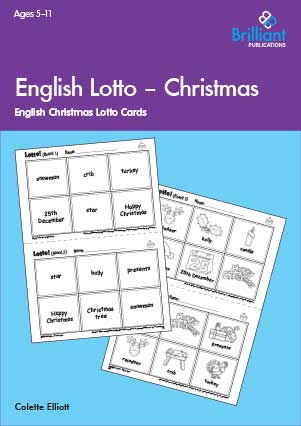
English Lotto – Christmas
Games are the best way to learn vocabulary and never more so than at Christmas time! Use these reproducible lotto boards to help teach and reinforce 12 key Christmas words in English. Vocabulary lists translate all the words used into French, Spanish, German, Italian, Portuguese, Welsh and Polish. These attractive, easy-to-use reproducible lotto boards provide a stimulating and meaningful way to develop reading, listening and speaking skills when teaching the topic of Christmas. Three versions of each board are provided - words only, words and pictures, and pictures only - allowing maximum flexibility, particularly in mixed ability classes. The unique call sheets enable you to follow the game closely and to select which team you want to win. Helpful ideas and tips for extending the use and complexity of the game are included.
Add to basket Continue
Loto Français – Noël
Games are the best way to learn French vocabulary and never more so than at Christmas time! Use these reproducible loto boards to help teach and reinforce 12 key French Christmas words. These attractive, easy-to-use reproducible loto boards provide a stimulating and meaningful way to develop reading, listening and speaking skills when teaching the topic of Noël (Christmas). Three versions of each board are provided - words only, words and pictures, and pictures only - allowing maximum flexibility, particularly in mixed ability classes. The unique call sheets enable you to follow the game closely and to select which team you want to win. Helpful ideas and tips for extending the use and complexity of the game are included.
Add to basket Continue
Le 14 juillet – Bastille Day
Use these lesson ideas to increase your pupils understanding of the tradition of Bastille Day and why it is celebrated as the French National Day. The significance of the day will be highlighted whether you decide to wear tricolore clothes or march as if on a military parade. Includes background information on 'le quatorze juillet' as well as information on French symbols such as Le tricolore and La Marseillaise.
Add to basket Continue